Pages

Those Quirky Swedes!

Tuesday, June 04, 2013

Our book club pick this past month was The 100 Year Old Man Who Climbed Out the Window and Disappeared.  Hailed as a Forrest Gump-like story, the book follows Allan Karlsson, a 100 year old man who decides he's had enough of the old folks home where he lives, and runs away by climbing out his
window and disappearing into the countryside.  What follows is a novel told alternately in flashback and present day.  As Karlsson and the band of misfits he gathers travel around Sweden to avoid a motorcycle gang that is chasing them (Allan stole a suitcase full of money on a whim in a bus station), the author tells us about his very interesting life prior to his arrival in the old folks home.

I will admit that I only got 50% of the way through this book.  Most of the women in my book club either didn't finish it, or reported liking the modern day story much more than the flashbacks.  I's have to agree.  The vision of this elderly man on the run with a petty criminal, an almost-doctor, a retired nurse, and an elephant was pretty amusing.  And the writing style was very quirky.  In truth, the writing style reminded me a bit of Jospeh Heller in Catch-22, only with way less nonsense and absurdity.  Karlsson's character, an explosives expert by trade, managed to get pulled into almost every major political event of the 20th century, from being at Los Alamos during the building of the atomic bomb, to being hired to blow up Winston Churchill after World War II, to having dinner with Truman...and that's as far as I got, because frankly everything that happened to him was so far fetched I was unable to sustain my suspension of disbelief.

I didn't stop reading because I was hating the book, however.  It was more that I found myself completely apathetic about the characters and what happened to them.  I found there to be very little emotional impact in this book, and it made it difficult for me to really care about what happened to any of the characters.  It was mildly amusing, but not enough so that I felt compelled to keep reading.  That said, the book has a four-star rating on Goodreads and Amazon, and it's been a best-seller, so obviously lots of people do like it.  I guess it's just not my cup of tea.

Cross-blog Pollination: Dante and Aristotle Discover the Secrets of the Universe

Wednesday, May 22, 2013

This year, for the first time, the school district where I work included the winners of the Stonewall book award in its announcement of the American Library Association Awards, which includes the Caldecott and Newbery Awards for children's literature.  The Stonewall award is given to those high-quality books with lesbian, gay, bisexual, and transgender themes that are aimed at younger readers.  This was a huge symbolic milestone for me.  I was, to my knowledge, the first openly gay teacher in my school district when I came out 13 years ago, and the acknowledgement of books for children and young adults with LGBT themes felt like official acceptance.  I'd read from this genre pretty extensively for a diversity project during my master's degree in reading, but since then I have not always kept up with new books with LGBT themes.

Dante and Aristotle Discover the Secrets of the Universe by Benjamin Alire Saenz was a Stonewall winner for 2013, and within a month of the announcement I had seen it referenced, or had it recommended to me, at least a dozen times. And it deserves the praise!  It tells the story of 15 year old Ari, a loner living in a Mexican neighborhood of El Paso, and Dante, the quirky, outgoing young man who becomes his first true friend.  Both Ari and Dante are dealing with the usual host of adolescent issues-redefining your relationships with your parents and family, navigating the treacherous waters of the high-school social strata, transitioning to adulthood, and, of course, dating and first loves.  With Dante, Ari finds an unexpected friend; effusive where he is reticent, affectionate where he is reserved, outgoing where he is taciturn.  For some reason, this friendship works for both of them, and the boys share many secrets with each other over the course of their friendship.  Ari finally has someone to talk to about the brother in prison that his parents won't even acknowledge exists, and Dante finally has someone to whom he can admit that he would rather kiss boys than girls.  Ari's feelings about Dante are confusing and unsettling, and their friendship is not always smooth sailing, but in the end both boys find comfort, a deep kindness, and love.

One of the wonderful things about this book is that while it has strong LGBT themes, it is not just a "gay" story.  Like any "real" person, Ari and Dante are both more than just their sexual orientation, and Saenz does an excellent job of showing the intersection of things family connections, ethnic identity, and sexual orientation in creating identity.  To be honest, while I was certainly drawn into the story of Ari and Dante's friendship, the part of the story that was the most touching to me was Ari's relationship with his father, a Viet Nam veteran who never left the war behind.  Their interactions, and Ari's longing for meaningful interactions with his distant father, are a large part of the emotional engine that drove this story.  Saenz also takes on the issue of gay bashing, which despite the improvement of the general climate for LGBT people in our country is still too often occurring.  The fact that the novel is set in the late 80s, when I myself was about the age of Ari and Dante, gave it a certain resonance for me that a young adult reader wouldn't have, but Saenz did a good job creating an authentic setting that any reader should be able to appreciate.

The Session, by Judith Kellman

Monday, May 13, 2013

Meh.

OK, I guess that's not really a review, though that is pretty much how I felt after finishing this mystery/thriller. The premise sounded promising.  P.J is a psychologist at Rikers Island women's prison.  During a "wedding" that she approved between two inmates, one of the "brides" was killed.  P.J. is blamed, and fired as a result.
She thinks that her biggest problem is making her rent, until she gets a call from one of her former patients at the prison, who is sure that she saw the victim's husband, a known batterer and sociopath, at the prison the day of the murder.  When P.J. can't get the police to act on the word of a schizophrenic inmate, she decides to investigate on her own.  Chaos ensues...blah blah blah.

Here's the deal.  P.J. as the narrator is self-deprecating and funny-or at least, Kellman tries really really hard to make her that way.  Too hard, in fact.  The one-liners and sarcastic rejoinders (both internal and between characters) felt forced to me.  And I didn't really buy the story.  As an Alex Delaware fan from way back, I'm willing to go with the "mental health professional turned investigator", but in this case I couldn't really figure out P.J.'s motivation for getting involved, nor did I really believe the path her investigation took.

There were some things that worked in this book's favor.  P.J.'s relationship with her extremely successful deaf sister was interesting, as was her complicated relationship with her ex-husband, who just happened to be (you've probably guessed already) a district attorney.  And there was a sub-plot involving P.J. and her brother Jack that was sort of interesting on its own...at least, it was until it became completely predictable.  But Kellman did a decent job of doling out information in such a way that I kept reading until the (unsatisfying) end.  So, in the final analysis-not awful, not great.

Meh.

I Hunt Killers, A Not So YA Young Adult Thriller

Thursday, May 02, 2013

As a long time reader of mysteries and thrillers, it can be hard for new authors to hook me.  There are so many series that I love, from Jonathan Kellerman and his wife Faye, to Sue Grafton, Harlan Coben, and Dana Stabenow.  I've read various iterations of the female private eye, the mystery-solving psychiatrist, or the gruff police detective, and it is rare that an author brings anything truly new to the table.  So imagine my surprise when I discovered a something novel and, frankly, really fascinating in a young adult thriller.

I Hunt Killers is the first novel by Barry Lyga, and I discovered it while attending a reading conference with my best friend.  As good as the workshop sessions are, the best part of the conference for me is the exhibit hall.  It is full of books and people (mostly teachers) who love books, milling around, flipping through pages, sometimes getting so engrossed that you realize you've already missed that session you were planning to go to.  I discovered this title at a booth for a small, local bookseller that deals primarily with schools.  It was hard to miss...the cover art if pretty striking and frankly I was a little surprised to find it with the other young adult books.  But after reading the blurb my friend and I both decided that we had to have it.  The premise that Lyga puts out is pretty simple, but ripe with possibilities.  The main characters, Jazz, is the son of a notorious serial killer.  Raised in the "family business", Jazz is now 17.  His father has been in prison for four years, and on top of the normal travails of adolescence, Jazz is trying to figure out whether he has become the things his father always wanted him to be-a sociopath.  When murders start happening in his hometown, murders that are eerily similar to his father's, he gets drawn into the investigation, and realizes that his horrific upbringing makes him uniquely qualified to help the police.  Jazz doesn't need some fancy profiling course from Quanitco-he finds he can think like a serial killer.  While this is a pretty great skill for solving the murders, it raises a whole host of questions for Jazz about his own identity, and his own capacity for violence.

I find this whole idea of the child of a serial killer becoming a hunter of serial killers fascinating.  I think that one of the reasons I read books about fictional serial killers, or watch documentaries about real-life ones, is because I want to figure out what it is that creates these human monsters.  As a person who believes people are inherently good, I want to know what went wrong along the way that created personalities with no remorse, empathy, or basic human emotion.  Brain research is coming up with clues as to what makes a person become this very specific kind of killer, but so far there is nothing definitive.  At the very root of Jazz's story is the while nature/nurture debate.  How much of what we become is a result of our genetic make-up, and how much is the environment we grow-up in?  And what about free will?  Increasingly, the answer is that what makes us who we are is neither one nor the other, but both/and.  Our genetic make-up may predispose us towards a certain path, but the interaction between that and our environment is too complex and sophisticated to tease out easily.  Reading the book, I got the strong sense that Jazz is a moral person, but when he questions himself, as a reader I found myself doing the same thing.

This book was classified as young adult by the booksellers, and I have found it on young adult reading lists since.  The main characters is a teenager, which is often a pretty good indicator that the book was written for that age group.  But the book is pretty gory.  Violent acts are described in some detail, and there is a sinister air about the while story.  While it was an easy read, I was completely drawn into the story, and I didn't feel any of the disconnect that I sometimes feel when I read young adult books.  When an adult reads books meant for a younger audience, sometimes the connection that we feel with the story or the characters is more of a remembered connection than an authentically current one, if that makes sense.  Reading a book about first loves brings back my own, but I don't have the same emotional response to it I would have had 25 years ago.  But with this book I was completely engaged the whole time, not just in the plot, which is in the end is fairly formulaic (it is essentially a procedural, after all)., but with Jazz as a character and the emotional roller-coaster he is on.  Perhaps what makes this story universal is that the journey of self-discovery and the creation of identity doesn't end in adolescence, and I suspect (and hope) that it continues as long as we live.  We might not be wrestling with whether or not we are a sociopath, but I think that each of us wrestles daily with being the best person we can be, which created a connection between Jazz and myself as the reader.

This is the first book in a series, which I could tell would be the case about half-way through the book.  I've already bought the second, Game, and I'm looking forward to seeing where Jazz's journey takes him-and the reader-next.


In Defense of Reading Young Adult Literature

Tuesday, April 30, 2013

I've always considered myself an equal opportunity reader.  I love a good literary novel, and I'll occasionally read some non-fiction, but I also enjoy lots of genre fiction.  Not that genre fiction can't be literary...see, this is where I start to have problems with the "experts" of the literary world.  I want my reading selections to have some substance-for mindless distraction I go to reality television (though usually of the "talented people doing things I can't do" variety a la Top Chef or Project Runway).  But who's to say that high fantasy or a procedural thriller can't have substance?

Nowhere is this bias more obvious when reading the more "serious" book bloggers I know than when it comes to young adult literature.  I've seen adults who read young adult literature described as everything from immature to unintelligent (a much nicer word than is occasionally used).  As a teacher and literacy coach, it is actually part of my job to keep up with what's new and good in children's and young adult literature, but that is not the only reason that I enjoy-yes, actually enjoy as a reader-books written for middle grade and adolescent readers. These types of stories bring me back to my own childhood, or help me make sense of what the children and youth in my life may be going through, but they can also have something profound to say about the human experience and our relationships to each other that is just as eye-opening and thought-provoking as the best of "adult" literature.

Obviously, not all children's and young adult literature is created equal-just as not all adult literature is equally meritorious.  Good writing is good writing, and bad writing is bad...sometimes very bad.  While I got sucked into the Twilight phenomenon when my daughter read them in middle school, now that I have recovered from my vampire/werewolf fog I can recognize how badly those books are actually written.  But at the same time, the Harry Potter series or the Hunger Games trilogy point out how good writing and powerful storytelling can transcend the labels and often arbitrary decisions we make about what book goes where in the literary pecking order.

If you'll forgive me for a moment, I'm going to take you into the world of leveling books.  If you are not a teacher or a parent, you may not even realize that books are leveled according to readability and subject matter for the purpose of matching readers in schools with appropriate books.  There are various leveling systems that publishers and teachers use to determine what "level" a book is, but the one that is getting the most press at the moment is Lexile levels.  The common core standards that most states in the US have adopted to drive instruction for elementary and high school students use Lexile ranges to place books in a continuum for guiding instruction. The reason I bring this up is that what a Lexile really measures is readability-in other words, at what point in their development as readers should a child be able to actually read and have a basic understanding of the words in a book.  There are some literary types who would have you believe that in order for a book to be substantive and achieve that coveted title "literary fiction", it needs to be difficult to read.  Being an "easy read" is somehow seen as a negative.

But let's look at the Lexile level of some classics, books that are considered examples of the best of English language literature.  A Tale of Two Cities, by Charles Dickens, is admittedly one of his shorter, more accessible titles.  But even so, it has a Lexile level of 460L.  Roughly, that equates to a 3rd-grade reading level.  Yes, you read that right, third grade.  Does that mean that the issues raised in the book are accessible to a third-grade student?  Of course not.  But it does raise the question of whether "literary" and "difficult" necessarily go together.  Huckleberry Finn, at 850L, is roughly fifth-grade level, The Iliad is fourth-grade level, as is The Handmaid's Tale and The Grapes of Wrath.  Given that the readability of these classics is so low, it is obviously more than the relative ease or difficulty of reading them that makes them remarkable.  So why is it so hard to imagine that literature written specifically for young adults, literature that might be "easy" for a skilled, mature reader to read, might have value?

I don't really care whether other people judge my reading habits because I happen to read a lot of children's and young adult titles.  I choose the books I read mostly for my own selfish reasons, as I assume most avid readers of any kind do.  But I think that this strict admonishment against reading young adult literature as an adult is silly, and cuts us off from some really excellent works of fiction.  Maybe you like all of your books to be a mental workout-if Ulysses and Gravity's Rainbow are your favorite books, then maybe young adult books or most genre fiction are not for you.  I myself read almost no romance or chick lit-those stories just aren't my cup of tea.  But I don't judge people who do, and that it is the point.  There are so many wonderful stories out there to discover-why make people feel as though they have to limit themselves based on the sometimes somewhat arbitrary classifications that the hoi polloi of literature and publishing have created?

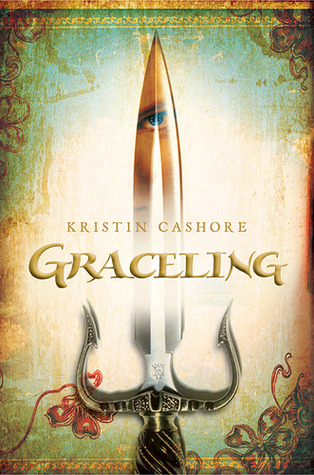
Cross-Blog Pollination: Graceling, by Kristin Cashore

Monday, April 15, 2013

Regular readers of this blog will know that I also write a blog devoted entirely to children's and young adult literature.  As a literacy coach, it is part of my job to keep up with the best in literature for young people, so that I can guide students and teachers in the right direction when it comes to what to read.

Occasionally one of the young adult books I read seems like it would also be enjoyable for adults, and when that happens, we get cross-blog pollination!  I think that adult readers who deny the enjoyability and relative value of books written for children and youth are denying themselves some very pleasant reading experiences-experiences that just might help them understand the world of children and youth, and the way that children and youth see the world.

This particular cross-pollination comes in the form of a fantasy novel called Graceling, written by Kristin Cashore.  Graceling tells the story of Katsa, a young woman born with a remarkable gift.  She has a Grace-a special ability that is innate, and that sets her apart from other people.  And Katsa's Grace requires her to keep people even more at a distance than usual, for her Grace is killing.  Her uncle, the King of Middluns, uses her to bully and threaten people who oppose him, and to get his way with the other kingdoms.  Katsa hates being his slave, but she considers herself to dangerous and flawed to do anything else.  That is, until she meets Prince Po of Leinid, another Graceling who is gifted with fighting ability.  His grandfather has been kidnapped, and Katsa is part of a team that rescued him from his captors. But even after he is safe, the question remains-why would someone kidnap an old man, even if he is related to the King of Leinid.  Katsa and Po will travel across the seven kingdoms to discover what nefarious plot is afoot, and along the way Katsa learns new things about herself, her Grace, and her ability to choose her own path.

Despite the fact that the "seven kingdoms" of Katsa's world immediately make me think of A Song of Ice and Fire, Cashore has created a fantasy world that is all her own.  The story moves at a good pace, and the emotions of the characters and the events as they unfold feel authentic within the mythology of the fictional seven kingdoms.  And there are some big questions addressed by the story-the nature of violence and freedom, the use of torture, naked power wielded cruelly, exclusion, the responsibility to use our "power" ethically, and the right to self-determination.  But what makes this a book I couldn't put down was Katsa's strength, determination, and unwillingness to be used as anyone's pawn.  Katsa is a hero, not in spite of being female, or because of being female...she is entirely her own person, operating almost completely outside of any gender roles.  There is a love story hidden within the action, but it is not what drives  the story; rather, the love story enhances the emotional impact of the true task of the characters-to save a princess, and in doing so their entire society, from an evil king bent on world domination.  This is a book that I will give to my daughter, and to the young teens I work with as a youth advisor, because Katsa is an example of a heroine that we can look up to, even when we may not agree with her every decision.  Because despite the violence of Katsa's Grace, what we see in her is the struggle all of us engage in every day to act in as moral a way as possible, even when people and events seem to conspire against us.

The Least Depressing Book about Death I've Ever Read

Wednesday, April 10, 2013

Occasionally my book club forces me to go outside of my regular reading comfort zone and try something that I would never have picked up on my own.  I remember thinking that I wasn't really interested in reading The End of Your Life Book Club, by Will Schwalbe.  It's non-fiction, for a start, though it is memoir, which I find much more enjoyable than other forms of that genre.  But I will admit to having some prejudices.  I imagined a book full of discussions about "how to deal with death/dying" books, and I was prepared for something akin to The Five People You Meet in Heaven (not that there's anything wrong with that-just not my cup of tea).

What I got instead was a smart, thoughtful, thought-provoking look at the end of a remarkable life.  Will Schwalbe's mother, Mary, was diagnosed with pancreatic cancer in 2007.  She was a strong, confident, socially conscious woman who had worked for years supporting refugees in war-torn parts of the world.  She had traveled to some of the most dangerous places in earth, and when she came back from a trip to Afghanistan feeling ill, at first no one thought too much of it.  But what her doctors thought was a form of hepatitis was soon revealed to be tumors in her pancreas, which had already spread to her liver.  And while treatment could extend her life, the illness was terminal.  This left Mary with the task of living while dying, and her family the task of figuring out how to relate to their spouse and mother knowing her time was limited.

Will would often accompany his mother to her chemo treatments, and it was in the waiting and treatment rooms at Sloan-Kettering Hospital in New York that they started what was to become a two-person, mother-son book club.  Both Mary and Will had always been avid readers, and the books they chose to read were either old favorites or new stories they discovered with and for each other.  The chapter titles are the titles of the books they read together, and each book frames a different part of their experience.  Some of the books had new meaning reading them while in the process of dying.  Some of them reminded Mary or Will about the things that were important in life, and all of them were high-quality literature.  My fears of a book full of trite, sentimental soundbites and self-help advice were unfounded.  In fact, as I read I found myself drawn more into the books they were reading than the story of their relationship.  I got a new reading list out of it, in fact.

That's not to say that the story was moving and emotional on a personal level.  Will and his mother had the enormous privilege of having the means and opportunity to spend this time together.  At several points in the book, Will or Mary points out how lucky they are to be in a position for her to get the best possible care, or for Will to quit his job and take on a new venture without worrying about losing his house or feeding himself. But ultimately, all of the money and education and connections in the world could not stop the inevitable progression of her disease.  Rather than railing against his mother's fate, Will is grateful for the time they were able to have, memories that will now forever be associated with the many wonderful books they read and loved together.
 
FREE BLOGGER TEMPLATE BY DESIGNER BLOGS