Pages

Showing posts with label fantasy. Show all posts

The Final Empire (Mistborn Book 1), Brandon Sanderson

Monday, June 11, 2018

Frequent readers of this blog probably know that I am a fantasy nerd from way back. Beginning with The Lion, the Witch, and the Wardrobe, continuing through Susan Cooper's The Dark is Rising series, The Elfstones of Shannara, The Thomas Covenant series, and Anne McCaffery's Dragonriders series, I have spent a good part of my life escaping into fantastical worlds where magic is real and heroes save the world from evil monsters.

The Final Empire, the first book of Brandon Sanderson's Mistborn series, is epic high fantasy at its finest. The world Sanderson creates is one of order and stability. But that order and stability comes at a great price-most of the world's population, called skaa, is used as forced labor on large plantations, under the absolute and absolutely cruel power of a noble class. The Lord Ruler controls the Final Empire. He is treated like a god, revered and hated, seemingly immortal. His dictates are enforced by a brutal group of priests called Obligators, all of whom are allomancers-people who have the power to use ingested metals for magical purposes. He also controls the dreaded Steel Ministry, creatures with spikes for eyes that can command the power of allomancy in ways more powerful than any regular human.

One man has vowed revenge against the Lord Ruler for his many atrocities. Born a skaa, Kelsier is a skilled Mistborn-an allomancer who can use all of the metals, rather than just one as most allomancers can. He develops a plan for overthrowing the Lord Ruler, and thinks he has discovered a way to kill him, using a previously unknown 11th metal. While planning this rebellion, he discovers Vin, a full Mistborn girl who was raised in the streets as part of a thieving crew. Vin is timid and suspicious of everyone, a result of years of abuse by her brother and various crew leaders. Kelsier undertakes to train her, and brings her into his own crew. Kelsier's plan seems insane-to create a skaa army and take over the capital city of Luthadel. But just maybe his plan is crazy enough to work.

The plot is well-crafted, intricate even, and despite the many characters and the almost constant machinations that are happening throughout the story, the whole things holds together beautifully. While Kelsier is the main actor, Vin is the heart of the story. Waifish, paranoid, and skittish, she survived the streets through her own wit and inner strength, calling on allomancy even before she knew what it was. Her transformation from distrusting, angry girl to full, beloved member of Kelsier's crew gives the story an emotional impact it would otherwise have lacked. The action is well-paced, with detailed descriptions of fight scenes that really give the reader a sense of what allomancy would be capable of.

The world-building is exceptionally well-done as well. Despite being what I would consider high fantasy, there are none of the standard high fantasy characters here-no wizards or trolls or elves. Instead, Sanderson created a world unlike any I've read before, with allomancy as the main driver. It includes magical creatures such as the kandra, as well as a race called terrismen, allow Sanderson to write in twists and turns that would be impossible, or at least unlikely, with only human characters.

I'm on to book two, which is so far just as good as the first. I look forward to seeing where the story goes.


The Hundred-Thousand Kingdoms, N.K. Jemisin

Tuesday, March 06, 2018

I posted recently about the Broken Earth series by N.K. Jemisin, a series I read (well, OK, listened to) like it was my job. Jemisin created a fantasy world like I had never seen before, with elements of science and magic that were completely new in my experience as a fantasy reader. She's done it again with The Hundred-Thousand Kingdoms, the first book in the Inheritance series.

Yeine Darr is the leader of the small, barbarian nation of Darr when she is called to the capital of the Hundred-Thousand Kingdoms, Sky. She is the daughter of Kinneth, an Arameri nobel, daughter to the current head of the clan. Kineeth was disowned by her father when she married a non-Arameri and escaped with him to his tiny nation of Darr. Teine's grandfather, Dekarta, head of the Arameri clan and king of the realm in all but name, has selected her as one of his heirs. However, this is not an occasion for celebration. Dekarta has no intention of Yeine ever actually taking the seat of power. Her job is to be the family sacrifice to the god Bright Itempas, naming another as heir in the moment of her death.

Into this already complicated situation come the Enefada, consisting of the god Nahadoth, brother to Itempas, and his children. They have been enslaved by Itempas to serve the Arameri as punishment for losing the Gods' War millennia ago. The Enefada have spent centuries trying to free themselves from their captivity, and they see Yeine as just the ally they need. Yeine, for her part, wants vengeance on Dekarta and the Arameri for her mother's death, and so agrees to align herself with the Enefada to take down her clan. Let the scheming and conniving begin!

Much like in the Broken Earth series, Jemisin's worldbuilding is unique and unlike anything else I've read. Despite how much action there is, almost all of the story takes place inside the palace of Sky. The story is taut with tension, and unlike the Broken Earth series, it is also full of sensuality and some pretty explicit sexy-time. It is very definitely a fantasy novel for adults. It deals with themes of love and betrayal and revenge and destiny...there are so many facets of the story that it was sometimes hard to keep them all straight. Once again Jemisin makes good use of first-person narration, telling the story from Yeine's perspective, allowing the reader to feel the full weight of the many emotional aspects of the story. By the time the story concludes, I felt like I'd been put through the wringer, but in the best possible way.

The story continues in The Broken Kingdom, which I am about a third of the way through now. It picks up the story some years later and introduces a whole cast of new characters that bring a new point-of-view to what you already think you know. I'm excited to see where Jemisin takes the story next-with her, you never know, even when you think you do!

The Broken Earth Series, N.K. Jemisin

Sunday, February 04, 2018

I don't usually write reviews of an entire series all at once, but I'm making an exception for The Broken Earth series by N.K. Jemisin. I listened to the entire series straight through on audiobook, and the experience was exactly what I hope and dream about when it comes to fantasy and sci-fi novels. It completely transported me to a different world, and no matter how long or short the drive, I was always sad when I reached my destination and had to stop listening. Beginning with the first book, The Fifth Season (the other books are The Obelisk Gate and The Stone Sky), Jemisin builds an intricate story full of nuance and emotion and thought-provoking themes.


Jemisin created a world that might be a future version of earth. The world is once again one large continent, surrounded by oceans with a few islands and lots of empty water. Society is divided into factions based on the type of work a person does: manual labor, leadership, storytelling, wood-working, etc...Every community, or "com", has members from each faction working together under a headman or woman. There is one group, however, that no one wants in their com, though they are happy enough to accept their help if there is an earthquake-the orogen. Orogens have the ability to control rocks and minerals, and they protect human settlements from earthquakes and volcanoes and the like. Despite their importance to the society, they are looked down on as violent sub-humans who must be controlled at all times by Guardians, who condition the orogenes to consider themselves tools rather than people.

The main character is an orogene named Essun, though we discover that is only one of her names. She has been hiding her powers by pretending to be a "still", the name for non-orogenes. She is married to the com's stone knapper, and has two children-both of whom are also orogenes. Essun does the best she can to protect them and teach them how to hide their power, but when her husband accidentally sees her son using his, he flies into a rage and kills the boy. Her discovery of his tiny body coincides with a major tectonic event that ushers in what they call a fifth season-a time when humanity must hunker down and do their best to survive the effects of what they come to call the rifting, which spews ash and smoke into the air that completely blots out the sun and covers everything in rock and ash.

Essun takes to the roads, searching for her murderous husband and her daughter. At the same time, there are other forces working in the world that make a showdown between humanity and the earth (literally, the earth) inevitable. Told through a series of flashbacks alternated with present-day action, the series has so much happening in it that I find I'm having trouble summarizing it succinctly.

One of the things I found really fascinating, and effective, was the narrative structure. Much of the novel is told in second-person (yes, I said second-person), and it is only towards the end of the series that we discover who is doing the talking, though the "you" they are talking to is evident from the beginning. It is a unique way to experience a story, and I was impressed with Jemisin's ability to keep it up for three books. The fact that Jemisin carefully builds an intricate story where all of the various strands, including her choice of narrator, come together in the end in a cohesive way is a testament to her talent as a writer, especially given that there are hundreds and hundreds of pages that had to be coordinated.

Even if the writing was not as well-done as it is, the story itself would make it worth the read. I've read a lot of fantasy novels in my time, and it is hard to find stories that are truly different. This series is like nothing else I've ever encountered. And maybe the best part-the main character is a middle-aged black woman. She's strong and smart and powerful, who can do amazing things, but she is so much more than just her power. It's not every day you find a book with a middle-aged woman as the main character that isn't about losing or finding a man, or about finding her purpose post-child-rearing. If you are a fan of fantasy, or strong female protagonists, I can't recommend this series enough.

An Ember in the Ashes, Sabaa Tahir

Friday, February 02, 2018

I've been a huge fan of fantasy novels since at least fifth grade. That Christmas I was gifted a box set of the Narnia books by C.S. Lewis, and by the time I went back to school after winter break I had read all The Lion, the Witch, and the Wardrobe twice. I devoured the Xanth series by Piers Anthony, battled the forces of Darkness with the elves in the Shannara Chronicles, and sailed the oceans of Earthsea (rest in power, Ms. LeGuin). As such, any new fantasy book I read has a pretty high bar to cross; it's got to take me on a fantastical journey I've never been on before, or take a tried and true fantasy story and turn it on its head. Such was the case with An Ember in the Ashes, the first book in the Ember in the Ashes series by Sabaa Tahir.
seven of them, and

The story has many common fantasy elements. A poor girl with untapped magic, the son of a noble house who wants to escape from the expectations placed on him, a war for the soul of the empire-your typical fantasy stuff. What's different is the setting. The book is set in a fictional place that is very much like the Middle East-less unicorns and satyrs, more ifrits and jinns. The first book follows two main characters; Laia, a Scholar, and Elias, a Martial Mask in training. The Scholars are a race of people who once ruled much of this fictional world; a people of art and culture and learning. A couple of generations ago, they were invaded by the war-like Martials, who forced them into ghettos and made reading and writing by Scholars illegal. They live in continual fear of the Masks, a group of highly trained Martial assassins who maintain strict control over the Scholars through brutal violence and a complete lack of compassion or empathy.

When Laia's brother is arrested, she goes undercover as a slave in the school where Martials are trained to gather intel for a resistance group who has promised to rescue him. Elias is about to graduate from the school a full-fledged Mask, but he has plans to run away to avoid becoming the souless, violent monster most Masks are. Laia and Elias meet, and their plans become embroiled in even bigger plans the universe seems to have in store for them.

The story is told from alternating perspectives, and the first person narration of both characters adds to the depth of their development. There is action aplenty, but the plot is rich and detailed enough to balance it out. There are some fairly graphic descriptions of violence done to individual people, so the weak-stomached might not enjoy it. It is a rare book that I think would appeal equally to male and female readers; there really is something for everybody (though I generally reject the idea of "boys" and "girls" books, I also live in the real world). As the beginning of a series, it does an admirable job of telling a complete story, and setting the reader up for the next installment. I broke my own "no-binge" rule for book series and started the second book immediately, An Ember in the Ashes was THAT good. I highly reccomend it for anyone who loves fantasy, YA or adult.

Anansi Boys, Neil Gaiman

Thursday, January 25, 2018

Neil Gaiman is one of my very favorite authors. His imaginative worlds and beautiful way with language make his books some of my very favorites to read. In preparation for the series American Gods, I decided to revisit both the book that series is based on and it's companion, Anansi Boys. This
time, though, I did the audiobooks, and I am really glad I did. My review of the writing is below, but I want to start with a shout out to the narrator of the audiobook, Lenny Henry. He pulled off British, American, and Carribean accents, as well as voicing several gods. I was completely sucked in by his narration.

Anansi is a mythical character from African folklore, a trickster god who bedevils man and god alike. Anansi stories have been popular for ages; I remember teaching an Anansi picture book when I was still a classroom teacher. In Anansi Boys, Gaiman takes the god out of legend and places him in retirement in Florida. When he dies, his son, tragically nicknamed Fat Charlie, travels from his home in England to his father's funeral. While there, he discovers he had a brother that no one ever told him about. His father's elderly neighbor tells him to whisper to a spider if he wants to meet his brother, and feeling rather foolish he does just that. When his brother, named Spider, shows up, Fat Charlie's life takes a decidedly frightening and crazy turn.

Anansi Boys has lots of the dry wit that I love about Gaiman's adult fiction, and while much of the action is humorous or downright absurd, he also provides some truly chilling scenes. Poor, hapless Fat Charlie is the perfect straight man to his brother's shenanigans and the eccentric ladies who try to help him solve the problems his brother creates in his life. Compared to American Gods, which ends up being very dark and full of violent imagery, Anansi Boys is almost whimsical, though it is not without it's tense, terrifying moments. The Anansi of this book has some recognizable elements from the Anansi in American Gods-his trademark hat, his smooth talk, his playful nature-but is much better developed, even though he is really only present for a small portion of the book.

I remember wondering when I read Anansi Boys for the first time if Gaiman planned to make his Old Gods stories into a book series. There were so many gods mentioned in American Gods that could be explored-Mr. Wednesday, Easter, the Russian sisters and Czernobog, Bilquis, Ibis and Jackel. So far there is no sign that is a thing that will happen, but hope springs eternal! Humans have created so many gods over the millennia that an author would surely never run out of source material. So Mr. Gaiman, if you're reading this, this fan would totally be down with a few more adventures in the world of the Old Gods.

The Passage Trilogy, Justin Cronin

Friday, February 03, 2017

I have a rule about audiobooks. If I am going to spend the money to purchase them, I need to get the most hours for my money. Most of my audiobook purchases are epic fantasy novels like Robert Jordan's The Wheel of Time series, or long historical fiction, a la Ken Follett's Kingsbridge series. This also allows me to get looooong books read on otherwise "dead" time-when I am driving. This frees up my actual reading time for shorter novels that help me make my Goodreads goal (I know, I know...I might have a problem).

I recently read Station Eleven by Emily St. John Mandel (review to come, I promise), and one of the things she shares in the afterword is the title of a novel that she made passing reference to within the context of her story. To be honest, I don't even remember the reference from Station Eleven, but I was so in love with that book that I figured if she liked it, surely I would too.

The book she mentioned was The Passage by Justin Cronin. Now, I had heard of the book before. Anyone who reads as much horror and supernatural fiction as I do can't help but run into the title, and I figured the fact that I even read the afterword of Mandel's book (I'm not so good about reading the forewords and endnotes of the novels I read. Mea culpa), was the universe's way of telling me it was time.

I'm always up for a new take on vampires (and werewolves and zombies and other creatures of the night), and Cronin's vision is at once completely new and utterly familiar. In the world of The Passage, a virus created by the US government (because who else) in an effort to create a super-soldier has been given to twelve convicted murderers living on death row (because expendable). When a mysterious event destroys the compound where the once-human-now-something-else creatures were kept, the "virals", as they came to be known, are unleashed upon an unsuspecting world (because of course), and quickly decimate the population, turning millions of people into blood-sucking monsters who prey on anything with a pulse.

The first book jumps back and forth between the time when the virals were being created, and a time about 100 years later, when what is left of humanity is dealing with the aftermath. Because the virus gives its hosts immortality, some of the characters overlap. There is a mysterious girl who was given a version of the virus that somehow did not turn her into a monster, the man who tries to save her, a nun who's life is unnaturally extended through some mystical force that never really becomes clear, a group of brave souls who strike out across the empty landscape to find help for their dying community, and lots and lots and lots of vampires.

Cronin has woven an intricate story of human connection and intense action. There are themes of love and family and faith and oppression, with sympathetic figures on both sides of the fight. Cronin's writing is full of beautiful, terrifying imagery, to the point that occasionally I want him to stop using so many words already and get on with it. But it's not because the words are unnecessary, like I feel with some authors <cough> Anne Rice <cough>, but because he's created such a compeling story that I can't wait to find out what comes next. I suppose if I was reading rather than listening to the books, I'd probably be skipping those long descriptions in favor of getting to the action, and I would surely be missing out.

My Favorite New Fantasy Series

Friday, August 19, 2016

I am a big fan of high fantasy. I got my first taste from the Narnia books, and was gifted the Shannara series as a middle schooler. Give me a series with elves and dwarves and trolls and chances are pretty good I will love it.

Not so sure I would have said the same about a fantasy series that revolves around necromancy, but that was before I discovered Sabriel, the first book in the Abhorsen series by Garth Nix. There are no elves or dwarves to be found, but there is a strong, female main character. Sabriel is the daughter of the Abhorsen, the good necromancer whose job it is to send the dead back into death, thereby undoing the work of the bad necromancers, who bring the dead back into life. When her father disappears, Sabriel is forced to leave the relative safety of her boarding school and venture into the Old Kingdom, where magic rules and technology is useless. She begins a quest to free her father and defeat an evil greater than she imagined.

One of the things I've loved about this series so far is the strong female leads. Sabriel portrays the titular young woman as someone who loves firecely, who thinks on her feet, who is more than willing to venture into the land of the dead to save people she loves. The setting is interesting-the Old Kingdom is full of magic, but it is bordered by a world that has what seemed to be mid-20th century-type technology. It gives the whole thing a bit of a steampunk vibe. I'm about a third of the way through the second book, and the strong female thing continues through that book as well. The mythology that underlies the action is different than other series I have read, which makes the story feel fresh. An added benefit is that I've been listening to it on audiobook, and Tim Robbins is the narrator. I discovered this series on a list of young adult books, but I really think that adult readers of fantasy novels will also enjoy it.

Revival, Stephen King

Tuesday, April 14, 2015

Stephen King's latest novel continues his long tradition of using events from his own life to inform the lives of his extremely well-crafted and believable characters.  Revival is the story of fanaticism and addiction and magic (or science?  Magical science?  Scientific magic?).  The main character is Jamie, who first meets Rev. Jacobs when he is a young boy living in a small town with his parents and siblings.  Rev. Jacobs and his young wife take over the struggling church in town, and turn it into a thriving congregation, complete with an active youth ministry.  All of the young people in town love Rev. Jacobs and his beautiful, talented wife, and they are taken in by his adorable little boy.  When tragedy strikes the Jacobs family, Rev. Jacobs preaches a sermon that gets him driven out of town.

Years later, Jamie is a strung-out rock guitarist who is one high away from being incarcerated or dead. When he stumbles upon the Rev. Jacobs at a carnival, he can barely believe what he's seeing. The former minister has taken his lifelong fascination with electricity and devised some truly amazing optical illusions.  But that's not all Charles Jacobs has discovered.  The man formerly known as Rev. Jacobs thinks he can help Jamie with his little addiction problem, but the help will come at a price that Jamie isn't sure he's willing to pay.

King himself famously dealt with an addiction to pain killers after a near-fatal car accident left him in near constant pain for years as he recovered.  Jamie's drug addiction certainly mirrors his experience to a certain extent, but it is Rev. Jacob's addiction that is the truly frightening part of this story.  While this story is not horror in the traditional sense, there is that element of the supernatural that infuses almost all of King's works in some way.  This time the "magic" is presented in the guise of science that we don't yet understand, and highlights the dangers of playing around with natural forces without really understanding the possible consequences.

The story also explores the nature of faith, both in the opening section when Jamie is a child, and later in the book when the Rev. Jacobs becomes a faith healer.  The power that Jacobs had was terrifying, but couched in the language and ritual of religion people were more than willing to be taken in.  People who are desperately searching for an end to their fear, pain, and despair become easy marks for a con man.  But was it a con?  If people really were healed, did it matter where the power came from? When Jamie discovered that the people who were healed didn't always stay that way, he became determined to stop Jacobs.  Determined, that is, until it was his own high school sweetheart who needed help.  As usual, King shines a light on human nature in all of its flawed beauty.

The Metaxy Project

Friday, July 25, 2014

Layton Green is an author that I discovered when he reached out to me about reviewing a new series he was writing, the Dominic Grey series.  That series now has three titles (The Summoner, The Egyptian, and The Diabolist), and I found them to be a delicious combination of well-paced action and interesting information about cults, the occult, and the psychology surrounding them.

Green is back with a new stand alone novel, The Metaxy Project.  Like his previous books, Green explores the supernatural from the point of view of a skeptic.  In this case, the skeptic is a young man named Derek Miller, a poor kid from the wrong side of the tracks who had the good fortune to start a friendship with a rich kid from an influential family.  When his friend is killed in a car accident, his father (a wealthy, well-known professor and researcher) takes Derek under his wing and helps him get into and through law school.  Derek is just at the beginning of his career, and he has scored a plum job as an associate at a "biglaw" firm.  But when the professor is murdered, Derek is drawn into the search for the killer.  He discovers a super-secret government project related to the supernatural.  The government was experimenting with telekinesis, telepathy, and remote viewing in an effort to weaponize them.  Derek puts his life and sanity in danger to bring down the conspiracy and avenge his dead mentor.

This is going to be a strange connection, but Derek reminded me very much of the main character from the USA series Suits.  Both are young, down-and-out kids who are given a break by powerful men; both are whip smart and underestimated by those around them; both are prone to pretty women in distress.That's pretty much where the similarities end, but it did make me like Derek's character pretty much from the beginning, since I like that show so well.

As a skeptic myself, one of the things that I like about Green's writing is that he tries to make some connection between seemingly inexplicable phenomenon and actual science.  While the story in The Metaxy Project is very definitely in the realm of fantasy, it is not such a stretch, even for a confirmed atheist and realist like myself, to go along with the events of the plot.  Green's work is reminiscent of James Rollin's books, only smarter.  Whereas I sometimes read Rollin's stories with a good deal of eye-rolling at some of the more fantastical plot points, Green's stories sweep me up completely as a combination of reality and possibility.  While I certainly don't believe that things like mediums and ESP are evidence of some larger force at work, who's to say that science won't someday have an explanation for the seemingly supernatural experiences people have reported experiencing over the decades.

The Ocean at the End of the Lane

Thursday, January 16, 2014

I have a t-shirt that says "Authors are my rock stars".  It features a jaunty picture of Edgar Allen Poe wearing John Lennon-style sunglasses.  And aside from the clever mash-up of depressive, alcoholic 19th century author and free-loving  20th century musician, the message on the shirt is true for me, and I bet is true for many of you.  Sure, it would be cool to meet some of my favorite rock stars (John Bon Jovi comes to mind!), but if you really want to get me excited, tell me I am going to meet one of my favorite authors.

So imagine my delight, excitement, and butterfly-in-the-stomach inducing invitation to the wedding of a friend of mine at the home of none other than Neil Gaiman!  I won't bother to go into the ways in which my friend and Mr. Gaiman are connected...suffice it to say that he and his wife Amanda Palmer had graciously offered their lovely home in Cambridge, MA for the ceremony and reception.  (They have since moved, thereby negating any lingering stalkerish impulses knowing their address may have had.) Obviously I was thrilled for my friend and her fiance, and would have flown cross-country to see them wed regardless of the setting.  But Neil Gaiman!?!  He's near the top of my "prominent people dinner party" list-you know, that list of people that you would invite to a dinner party just to listen to the amazing wonderfulness that falls from their lips in between bites of exquisitely prepared gourmet food.

When I learned I would be meeting him, I quickly realized that it would be in my best interest to read his latest two books prior to the wedding.  Because clearly we would become fast friends and spend the entire evening talking about his amazing work.  (Spoiler alert:  this did not, in fact, come to pass.  I met him, congratulated him on his recent book awards, and then spent the rest of the evening too nervous and awkward to actually try to have a conversation with the man.  And you'll have to take my word for it that any of this actually happened-I was also too nervous and awkward to ask for a photo.)  Mr. Gaiman had two books come out recently.  One, a children's book called Fortunately, the Milk, is still in my to-be-read stack. But the other, The Ocean at the End of the Lane, I picked up immediately after getting the wedding invitation.

First, let me say that given the pretty short length and the age of the main character of The Ocean at the End of the Lane, I assumed it was another children's book.  Good thing I actually read it before I handed it out to any of the children at my school.  It may be short, and be mostly about children, but it is very definitely not for the under 12 crowd.  The story is told in flashback.  The narrator is a man returning to his childhood home for a funeral.  While there, he revisits places he knew as a child.  He find himself drawn to the farm at the end of the road, and to the pond that stands behind the neat farmhouse.  All those years ago, he met a girl named Lettie Hempstock and her remarkable family there, and as he gazes at the pond (which Lettie called an ocean), memories of the most terrifying time of his life come flooding back.  When a man committed suicide in his family's car, it created a soft spot in our world that allowed something horrible to come through, something that almost destroyed his family, and could have destroyed the world as we know it.  It is up to Lettie and her family to put things right again.

The suicide was the first thing that clued me into the fact that perhaps I had misjudged the intended audience for the book.  The fact that the evil thing that comes through the hole in the world seduced his father in the guise of an attractive nanny made it official.  But despite some very adult events, the book does read childlike.  Gaiman was able to capture what happened in a way that we understand it as a child might understand it, and it reminded me of my own childhood fears-fears about monsters and losing my parents. Those seem to be fairly universal childhood fears, and Gaiman uses them expertly to create a sense of menace, even though much of the book is not, in fact, violent.  And like the boy in the story, we are left wondering about the nature of Lettie and her family as much as we are about this monster and where it came from.  There is basically no back story for those characters in the book, at least not directly stated.  You can infer a few things from the abilities of the characters and the way they describe "crossing the ocean", but there is no grand explanation.  In the end it didn't matter.  The story has an emotional impact and a creepiness factor that are independent of the mythology of the supernatural characters involved.

I enjoyed The Ocean at the End of the Lane differently than I enjoyed some of his other books.  It's doesn't have the intricate plotlines of American Gods or Anansi's Boys, and I guess it comes the closest to Coraline in terms of its overall mood.  But it is truly a story like I have never read before, which I think speaks volumes about Gaiman's talent as a storyteller.  Maybe our paths will cross again someday, and I will overcome my awkwardness enough to have that conversation about his art.  But until then, I'll make do with his always entertaining and thought-provoking books.


Joyland, Stephen King

Sunday, August 25, 2013

King has tackled a lot of supernatural creatures over the years-mind readers, fire starters, vampires, werewolves, and really, really, REALLY creepy clowns.  But there is nothing he does as well as an old-fashioned ghost story.  He's written quite a few over the years (Bag of Bones being one of the better examples), and Joyland continues his tradition of creepy goodness!

Joyland is set in an amusement park, and the main character Devin comes there as a college student to work for a summer.  Heartbroken after losing his first love, he throws himself into the carny life.  While working at the park, he is drawn into a mystery-a young woman was killed on the haunted house ride.  People claim to have seen her ghost haunting the ride, and Devin's best friend has his own close encounter with the apparition.  Devin also befriends a dying boy who has the power to see things that most people can't see.  He tells Devin that the girl will not be at rest until her killer is found.  Devin is drawn into both the search for the murderer and a relationship with the boy's mother.

King does his usual masterful job of creating characters that almost leap right out of the pages into real life. There is a nostalgic feeling to the story, which is told as a long flashback from Devin's point of view, and which I've noticed in more of his books the older he's gotten.  King must have also done quite a bit of research into the world of carnies, which has its own culture and language. Like in many of his books, the character with a disability has some sort of special ability, which sadly does not keep them from tragedy.  As ghost stories go this one is less scary and more sad, given the circumstances of the girl's death.  As mysteries go it's pretty well done, with a noir feel that suited the setting perfectly.  On a scale of one to The Stand, I'd say this one is about an eight.  Easy to read, entertaining, and perfect for a lazy day at the beach, which is exactly where I read it.

Horns, Joe Hill

Wednesday, July 17, 2013

I was excited to find a copy of Horns at my local Big Lots (a store that sells odd lots and overstock from other stores).  I read Hill's fist novel, Heart Shaped Box, and thought it was a pretty good effort for a first novel.  I will admit to being predisposed to like it-Joe Hill is the pseudonym used by one of the sons of my favorite horror writer Stephen King, after all.  But still, I thought it showed promise.

Horns, while far from being perfect, definitely shows Hill's development as a writer.  The novel tells the story of Ig Perrish, a young man who had everything going for him, until the night that his girlfriend Merrin, the only woman he's ever loved, is brutally murdered.  Suspicion immediately falls on him, but with no evidence he is eventually released.  But in his small town, everyone assumes he did it, and his life becomes an endless series of accusatory glances and awkward interactions.  One night, around the anniversary of Merrin's death, he got raging drunk and blacked out.  When he awoke, he had more than just the worst hangover of his life-he had grown a pair of horns.  People suddenly start confessing their deepest, darkest desires to him, and he discovers that he can nudge people into acting on those desires in a way they would never have dreamed.  One of those people is his brother, Terry, who confesses something that starts a chain reaction of revenge that almost destroys Ig and everyone he cares about.

I thought that Horns felt more mature than Heart Shaped Box.  There was no real explanation of where the horns came from, but like his father he wrote a story that hooked me enough that I didn't really care.  I thought that sometimes he was a little too on-the-nose in his devil references...Ig's name being so close to the word for a church community, the blue skirt he ends up in later in the book (Devil in a Blue Dress)...I felt like these little flourishes weren't really necessary.  But Ig himself is pretty well written, and Hill did a good job making you feel what he was feeling when all of these things started happening to him.  And the premise itself is interesting.  What would it be like to hear everyone's most base desires, or to touch them and see all of the bad things they've ever done?  Frankly, if that's the Devil's job description, he really is living in Hell.


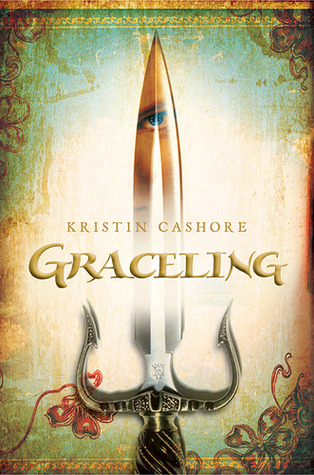
Cross-Blog Pollination: Graceling, by Kristin Cashore

Monday, April 15, 2013

Regular readers of this blog will know that I also write a blog devoted entirely to children's and young adult literature.  As a literacy coach, it is part of my job to keep up with the best in literature for young people, so that I can guide students and teachers in the right direction when it comes to what to read.

Occasionally one of the young adult books I read seems like it would also be enjoyable for adults, and when that happens, we get cross-blog pollination!  I think that adult readers who deny the enjoyability and relative value of books written for children and youth are denying themselves some very pleasant reading experiences-experiences that just might help them understand the world of children and youth, and the way that children and youth see the world.

This particular cross-pollination comes in the form of a fantasy novel called Graceling, written by Kristin Cashore.  Graceling tells the story of Katsa, a young woman born with a remarkable gift.  She has a Grace-a special ability that is innate, and that sets her apart from other people.  And Katsa's Grace requires her to keep people even more at a distance than usual, for her Grace is killing.  Her uncle, the King of Middluns, uses her to bully and threaten people who oppose him, and to get his way with the other kingdoms.  Katsa hates being his slave, but she considers herself to dangerous and flawed to do anything else.  That is, until she meets Prince Po of Leinid, another Graceling who is gifted with fighting ability.  His grandfather has been kidnapped, and Katsa is part of a team that rescued him from his captors. But even after he is safe, the question remains-why would someone kidnap an old man, even if he is related to the King of Leinid.  Katsa and Po will travel across the seven kingdoms to discover what nefarious plot is afoot, and along the way Katsa learns new things about herself, her Grace, and her ability to choose her own path.

Despite the fact that the "seven kingdoms" of Katsa's world immediately make me think of A Song of Ice and Fire, Cashore has created a fantasy world that is all her own.  The story moves at a good pace, and the emotions of the characters and the events as they unfold feel authentic within the mythology of the fictional seven kingdoms.  And there are some big questions addressed by the story-the nature of violence and freedom, the use of torture, naked power wielded cruelly, exclusion, the responsibility to use our "power" ethically, and the right to self-determination.  But what makes this a book I couldn't put down was Katsa's strength, determination, and unwillingness to be used as anyone's pawn.  Katsa is a hero, not in spite of being female, or because of being female...she is entirely her own person, operating almost completely outside of any gender roles.  There is a love story hidden within the action, but it is not what drives  the story; rather, the love story enhances the emotional impact of the true task of the characters-to save a princess, and in doing so their entire society, from an evil king bent on world domination.  This is a book that I will give to my daughter, and to the young teens I work with as a youth advisor, because Katsa is an example of a heroine that we can look up to, even when we may not agree with her every decision.  Because despite the violence of Katsa's Grace, what we see in her is the struggle all of us engage in every day to act in as moral a way as possible, even when people and events seem to conspire against us.

George R.R. Martin and I Are in a Fight

Monday, October 08, 2012

Of course, since he has no idea who I am, that probably doesn't mean very much, but still.  I recently finished the audiobook for A Feast for Crows, the fourth book in the Song of Ice and Fire series.  I was willing to forgive the length of the books because of the amazing amount of detail that he puts into the fictional world he  has created, even if it meant that I have to listen to them on audiobook instead of reading them in my all too precious free time.  And I know that part of my issue is the fact that this book and the fifth, A Dance with Dragons were originally supposed to be one book, until it grew to such behemoth size that it had to be divided.  But I'm miffed.  Thirty-plus hours and no mention of some of my favorite characters.  Plenty of mention of some of my least favorite, which is fine, I suppose.  And then lots and lots of new characters and new history and new families and new settings and new politics to learn.  And NOW, I've started A Dance with Dragons, hoping to find the answers to the cliffhangers set up in A Feast for Crows, only to discover that the two books are CONCURRENT?  So yeah, George R.R. Martin are in a fight.

That said, I'm completely sucked into the whole Game of Thrones universe.  I can't stop reading them any more than I can stop watching the show.  As far as the book itself goes, A Feast for Crows was an awful lot of exposition and not a ton of action, but it is worth it in the end when one of the most evil characters in the series appears to get what is coming to her.  Of course, I'll have to wait to find out, because instead of writing a continuation of the story in A Dance with Dragons, I have gone back in time to catch up with the characters that were excluded from A Feast for Crows.  But at least now I know where Tyrion ended up, and what was happening on the Wall after Sam leaves.  But I'm going to be really ready for book six.

Under the Heading of Places I Wish Were Real

Wednesday, February 15, 2012

Sometimes I read a book that has such a strong sense of place that I feel literally transported there.  Sometimes this is a bad thing, like in Elie Weisel's Night Or A Thousand Splendid Sun's Afghanistan.  But sometimes it is a wondrous feeling, especially when the place in question is full of magic.  This is how I felt when I read the Narnia books for the first time, and frankly I'd still like to visit Caer Paravel and hang out with Peter, Susan, Edmund, and Lucy.  Erin Morgenstern, in her debut novel The Night Circus, creates just such a magical place in Le Cirque du Reves, the setting for her imaginary game of one-upsmanship between two talented illusionists.

Celia and Marco are just children when their training begins.  Their teachers, Celia's father Prospero and Marco's guardian Alexander, are old rivals who have, over the years, challenged each other to a game.  The "game" involved pitting their pupils against each other in a challenge like no other.  Their task is to manipulate the physical world as a test of their skills, and their playing field is a circus-a magical circus that is only open at night. But things do not go as the old masters planned when Celia and Marcos stop seeing each other as adversaries and start seeing each other as something else entirely.

Le Cirque du Reves as imagined by Morganstern is a place full of amazing people doing amazing things.  There are the usual acts of contortionist and fortune teller, but there are also tents full of things that defy reality-a garden made exquisitely out of ice, a cloud maze that allows you to literally climb into the heavens, a wishing tree where wishes really come true.  Even if the book was nothing but a long description of the marvelous things at the circus I would have read it and been happy.  But there was also this really intriguing, mysterious story going on that had my interest piqued.  While I did not get all of the answers that I was hoping for about exactly what was going on, the fact that I am still thinking about the story and what it might have meant shows what an affect it had on my imagination.

I don't usually read other reviews of a book before I write my own, but I was curious about how other people were affected by the story.  I was not surprised to find that the New York Review of Books was not exactly over the moon about this book-I imagine if does not meet their rather high-falutin' definition of literary.  But the other reviewers I read all felt similarly to me.  For a first novel, this book does a pretty good job with evoking mood and setting up a solid plot structure.  Character development is oddly lacking, given the rich possibilities for the creation of a mythology to explain the enchanters and their pupils.  But unlike some of the other reviewers, I actually saw the circus itself as a character, or at least an extension of Marco and Celia.  I felt like a learned a lot about them through the kinds of creations they made for their customers.  I know that some readers may be put off by the non-linear narrative, but I didn't find it distracting at all, since each section is clearly marked, and there is no real jumping back and forth within sections, only between them.  One reviewer I read felt that the ending set up a sequel, but I'm not sure about that.  While the fate of the circus seemed rather open-ended, I was OK with it.  I like imagining the circus, traveling the world, appearing and disappearing like magic, delighting everyone who is lucky enough to discover it.

The Belgariad, by David Eddings

Sunday, November 06, 2011

Earlier this fall I posted a review of Pawn of Prophecy, the first book in David Edding's fantasy epic The Begariad.  I enjoyed it a lot.  I think that it is high fantasy at its best.  It had the usual cast of characters-sorcerers, knights, princesses, and the like-but it was smart and engaging.  I also reviewed the second book in the series, Queen of Sorcery, which I thought was a very good next step in describing the quest to find the Orb of Aldur and defeat the evil god Torak.


I have since finished he entire cycle-including Magician's Gambit, Castle of Wizardry and Enchanter's End Game-and I am please to say that the epic story of Garion and his journey from scullery boy to King of Riva and champion of the west was every bit as fun and exciting as the first two books led me to believe.  Eddings did a great job creating characters that were at once universal archetypes of western literary fantasy and completely individual.  While there was never really any doubt of the outcome-this is a classic good v. evil story after all, and we all know how those come out-there were enough twists and turns to keep you guessing.

One of the frequent complaints about high fantasy is how sexist it can be.  The men are warriors, the women are witches or princesses.  Eddings addresses that issue head on, acknowledging in this male characters that those attitudes exists, but countering them with his female characters, who he shows to be every bit as resourceful, strong, and capable as his male characters.  Unlike Tolkien, who's female characters were very one dimensional, Eddings shows women to be an integral part of the world that he created, and each has her own strengths and foibles.  All in all The Belgariad is a fine example of good storytelling-gently flowing language, interesting turns of phrase, characters that are believable even when they are doing unbelievable things, and exciting action sequences that stir the blood and the heart.

Queen of Sorcery, David Eddings

Monday, September 12, 2011

So a couple of weeks ago I posted a review of Pawn of Prophecy, the first book in David Edding's Belgariad series.  I talked about how it was a well-written fantasy series, with well-developed characters and well-paced action.  All the typical archetypes are there-the sorcerer, the witch, the warriors, the rogue.  It is an enjoyable journey in a sometimes dark fantastical world.

I just finished the second book in the series, that chronicles the further travels of Belgarath, Polgara, and Garion and their allies on their search for the orb.  As for my review of said book-I can only say...

ditto.

Clash of Kings, Or Why Fantasy Novels Should Come With a Score Card

Tuesday, July 12, 2011

I've been a fan of fantasy since I was a kid.  I remember getting the Narnia books for Christmas and reading them all before going back to school.  I remember getting The Wishstone of Shannara for Christmas a few year later and completely losing myself in the quest to save the tree...and how I cried when the elf had to sacrifice herself at the end.  I think that this is one of the reasons that I like role playing games like Final Fantasy or Fable-they are like living in the books I read growing up.


That said, it's been a while since I have gotten into a fantasy series.  I suppose some of the reason is because after reading so many they do start to blend together and feel like the same story over and over.  I experienced a similar phenomenon after years of reading almost nothing but mysteries and thrillers.  But I think that part of it is because fantasy stories have this perception of being childish or immature somehow.  I mean, serious, literary readers don't read genre fiction like fantasy, do they?

Then came Game of Thrones on HBO.  Because while I might have stopped reading much fantasy, I sure do love to watch it.  I've probably watched every Arthurian based movie and show made in the last 20 years, as well as any Robin Hood adaptation.  While I did read all of the Harry Potter series, I am just as excited about the movies coming out as I was the books (well, OK, maybe not just as excited, but you get my point).  Now, I have always been a proponent of reading the books that a series is based on.  I've scolded people for not reading the Southern Vampire books before watching True Blood, and I have waxed poetic on how much better the Temperance Brennan books are than the TV show Bones is.  So, after watching (and loving) the first season of Game of Thrones, not to mention hearing my many friends who've read the books lambast me for being a hypocrite, I gave in and downloaded the second book in the series, Clash of Kings, for my brand-spanking new Kindle.

I should have known that my friends would not steer me wrong.  George R.R. Martin has done something that most fantasy writers in my experience can't quite pull off-a grown up fantasy novel.  Clash of Kings tells the story of what happens in the Seven Kingdoms after King Robert is killed by a boar while hunting.  His "son" ascends to the throne, supported by his rich and powerful family, House Lannister.  Of course, thrones are rarely passed peacefully, especially when it is pretty apparent that the 13 year old "king" is in fact not King Robert's son, but a product of incest between his mother and her twin.  Three other men aspire to be king:  Robert's brothers, Renly and Stannis, and the murdered Eddard Stark's son, Robb.  The intrigue, violence, and betrayal that ensues are pretty much impossible to summarize, unless I want this post to be as long as the book (which at 761 pages is one of the longer books I've read this year).

The writing is smart and well-crafted, and the main characters are well-developed.  They are also fairly nuanced for a genre that lends itself to one-dimensional characters who are either wholly good or wholly evil.  I find that of my favorite characters, one is a member of that incestuous Lannister clan, despite the fact that in the arc of the story his family is pretty much completely cruel and morally bankrupt.  And this talk of character leads me to the subtitle of this post.  While I love my new Kindle, reading this book on an e-reader may not, in fact, have been the best choice.  I'm not sure that it is exaggerating to say that there are hundreds of characters mentioned in this book-both "present" day and past heroes-and not being able to flip to the maps of the pages tat listed how everyone was related to everyone else sometimes left me very confused. Short of reading with a computer next to me to look things up I was hard-pressed to keep it all straight.   In the end I decided to just go with it-after all, I'll have season two of Game of Thrones to explain whatever I missed.

Rediscovering the Punny World of Fantasy

Monday, May 16, 2011

For a period of a few years when I was in middle school and high school, I read almost exclusively science fiction and fantasy.  My love affair with science fiction started with A Wrinkle in Time, and my first fantasy love was The Wishstones of Shannarah.  I tore through the works of Terry Brooks, Lloyd Alexander, Susan Cooper, Stephen R. Donaldson, Anne McCaffery, and Ursula K. LeGuin.  One of my favorite authors from this period was Piers Anthony.  His Xanth novels were always light and amusing, and better yet, there were a TON of them.  I spent whole weekends ensconced in my room with a pile of Xanth novels, reading non-stop while listening to Abba on vinyl.  That's right, I was a total nerd, but a happy one!

Then I went away to college, and spent my reading time on textbooks instead of reading for pleasure.  Between that and the fact that I'd lost my book supplier (my mother, who was somehow not willing to drive two hours just to take me to the bookstore for more reading material), I didn't read a Xanth book for a long time.  When I finally did get back to them, I was saddened to discover that the puns that I thought were so funny and clever in my teens now seemed a bit immature.  I remember how sad I was at not really enjoying the books as I once had.

Fast forward 20 years, and I am once again in love with a goofy, pun-filled series of fantasy humor.  Terry Pratchett's Discworld series was recommended to me by a friend years ago, but for some reason I never managed to pick up any of his books.  Finally two circumstances fell into place-morning door duty and an iPod Touch.  One morning at school while on door duty, in between buses coming in, I was exploring my new iPod Touch, and there in the iBooks store was Terry Prachett's Color of Magic for less than $5.  The universe had finally brought Prachett and I together.

The Color of Magic is the first book in the Discworld series, though not necessarily the first book chronologically in the Discworld mythology.  In The Color of Magic we are introduced to Rincewind, a failed wizard living a dissolute life in Ankh-Morpork, a large city on the Disc, a world being carried through the universe by four elephants that are perched on a large turtle A'Tuin.  Rincewind chances to meet Twoflower, a tourist from across the sea, who has a magic chest that follows him everywhere.  What Rincewind doesn't know is that he and Twoflower are pawns in a large chess game being played by the gods and goddesses of the Discworld.  Rincewind becomes Twoflower's tour guide and protector, and they travel around the Discworld meeting all manner of magical beings, heroes, and danger.  Despite being completely inept as a wizard, somehow Rincewind manages to take advantage of every piece of luck that comes his way to help Twoflower and himself survive.

The books is full of puns, illogical magical mythology, and humor, just like the Xanth novels.  But unlike Anthony's series, The Color of Magic also feels more mature. A combination of satire and silliness, The Color of Magic is a light read, with layers of meaning that can be thought about-or not-at your leisure.  Pratchett's books are like a big "wink wink, nudge nudge" to the fantasy community, at once spoofing it and enriching it.  If you, like me, loved fantasy as a youth but find it rather immature as an adult, then Pratchett's books may be right up your alley.

From Dead to Worse, Charlaine Harris

Friday, March 11, 2011

One of my guilty pleasures is a love of all things Sookie.  While the TV show based on the book, TrueBlood, and the books have diverged pretty widely at this point, I figure that just gives me twice as much Sookie Stackhouse to love.  There is something very comforting about the predictability of the stories.  Sookie will be in mortal danger.  Some supernatural man (or woman, in the case of her fairy godmother) will have to help save her.  At least one supernatural man will be in love with her.  Chances are there will be some impediment to their love.  Wash.  Rinse.  Repeat.

So, here is my short summary of From Dead to Worse, book number eight in Charlaine Harris's Sookie Stackhouse series...missing weretiger, vampire takeover, fairy great-grandfather, werewolf war, revenge, werepanther justice, Eric remembers everything, Bill still pines...if you have read the Sookie Stackhouse books, you know what all of this means.  If you haven't, and you are interested and or intrigued by what it all could mean, go back to the beginning and start with Dead Until Dark, the first book in the series, and prepare to lose yourself in a funny, scary, surprising, completely unrealistic world that will provide the perfect escapism.
 
FREE BLOGGER TEMPLATE BY DESIGNER BLOGS