Pages

Showing posts with label King. Show all posts

My Year of King: Carrie, 1974

Thursday, January 11, 2018

Finally! I started re-collecting King's books at the end of 2017 in preparation for my 2018 goal to re-read all of King's books, and there they sat, taunting me, until the new year. I am so excited to start this journey into the world of Stephen King. I've read his books regularly since I was a teenager, and I am really curious to see how my reaction to his stories has changed as I have moved from adolescence into middle age.

Because I am reading the books in the order they were published, Carrie was up first. This was also the first King book I ever read, so we've come full circle. Going into it, I wondered if I would still find it as engaging as I did when I was 13, or whether the intervening years would change my opinion. If I started reading King today, would I still love his books as much as I do?

I am relieved to report that I enjoyed Carrie as thoroughly in 2018 as I did in 1983. While I now recognize that it reads more like a young adult novel in a lot of ways than I did when I was an actual young adult, it still captured my interest as an adult reader, and kept me hooked even though I already knew how the story would come out.

The story, for those of you who have managed to avoid both the book and the two movies based on it in the last 40 years, is about a teenage girl named Carrie. Carrie lives with her religious fanatic mother, a woman who is so hateful and cruel it almost defies belief. Because her mother won't allow her to have friends, dress like the other girls, or go out to school events, Carrie is an outcast, ostracized and bullied everywhere she goes. After an especially heinous bullying incident in the girl's locker room (scene of many cruel incidents, both fictional and real), Carrie discovers that she has an amazing power-she can move objects with her mind. More drama ensues both at home and at school, culminating in the worst.prom.ever.

Carrie introduces us to a few stylistic characteristics that will become well-known to regular King readers (or Constant Readers, as he called us). Throughout the book, he lets you know that folks are going to die, and when. He creates characters that feel like real people, though they are less nuanced than his later characters. One of the things I love about King is how even his villains are often sympathetic, or at least conflicted about the evil they do. The good guys and bad guys in Carrie are pretty one-dimensional in that respect. The bad guys appear to have no redeeming qualities, and even when Carrie is literally destroying her entire town you still feel sorry for her. But there are glimpses into the types of characters he will write later, namely Sue and Tommy, the "it" couple who play such a large role in getting Carrie to that fateful prom.

Overall, re-reading Carrie has got me super stoked for book number two, 'Salem's Lot. I remember enjoying it, but that was before the Twilight phenomenon caused the literary world to be Carrie it will almost be like reading it for the first time all over again.
oversaturated with vampire stories. I remember very few specifics about the plot of this story, so unlike

Revival, Stephen King

Tuesday, April 14, 2015

Stephen King's latest novel continues his long tradition of using events from his own life to inform the lives of his extremely well-crafted and believable characters.  Revival is the story of fanaticism and addiction and magic (or science?  Magical science?  Scientific magic?).  The main character is Jamie, who first meets Rev. Jacobs when he is a young boy living in a small town with his parents and siblings.  Rev. Jacobs and his young wife take over the struggling church in town, and turn it into a thriving congregation, complete with an active youth ministry.  All of the young people in town love Rev. Jacobs and his beautiful, talented wife, and they are taken in by his adorable little boy.  When tragedy strikes the Jacobs family, Rev. Jacobs preaches a sermon that gets him driven out of town.

Years later, Jamie is a strung-out rock guitarist who is one high away from being incarcerated or dead. When he stumbles upon the Rev. Jacobs at a carnival, he can barely believe what he's seeing. The former minister has taken his lifelong fascination with electricity and devised some truly amazing optical illusions.  But that's not all Charles Jacobs has discovered.  The man formerly known as Rev. Jacobs thinks he can help Jamie with his little addiction problem, but the help will come at a price that Jamie isn't sure he's willing to pay.

King himself famously dealt with an addiction to pain killers after a near-fatal car accident left him in near constant pain for years as he recovered.  Jamie's drug addiction certainly mirrors his experience to a certain extent, but it is Rev. Jacob's addiction that is the truly frightening part of this story.  While this story is not horror in the traditional sense, there is that element of the supernatural that infuses almost all of King's works in some way.  This time the "magic" is presented in the guise of science that we don't yet understand, and highlights the dangers of playing around with natural forces without really understanding the possible consequences.

The story also explores the nature of faith, both in the opening section when Jamie is a child, and later in the book when the Rev. Jacobs becomes a faith healer.  The power that Jacobs had was terrifying, but couched in the language and ritual of religion people were more than willing to be taken in.  People who are desperately searching for an end to their fear, pain, and despair become easy marks for a con man.  But was it a con?  If people really were healed, did it matter where the power came from? When Jamie discovered that the people who were healed didn't always stay that way, he became determined to stop Jacobs.  Determined, that is, until it was his own high school sweetheart who needed help.  As usual, King shines a light on human nature in all of its flawed beauty.

Uncle Stevie Learns a New Trick

Thursday, July 03, 2014

There are few writers as prolific as Stephen King.  While is is primarily known as a writer of horror stories,
he has also written science fiction (Under the Dome), a series of books with women's themes (Rose Madder), realistic fiction (Misery), and magical realism (The Green Mile).  And, of course, his epic fantasy series The Dark Tower.  Readers of this blog know that he is one of my very favorite authors.  I think that he is sometimes overlooked by critics of "serious" literature, because of his reputation as a horror writer, but as far as I'm concerned The Stand is one of the best novels of the 20th century.

But as far as I know, King has never written a traditional thriller-until now.  Mr. Mercedes, his latest book, is your basic serial killer story.  Bill Hodges, a retired detective in a Midwestern city, is haunted (though not literally, this time) by his last unsolved case.  Someone drove a Mercedes sedan into a crowd of people lined up to apply for a job in the early morning hours, including a mother and her infant.  Bored, overweight, and lacking purpose, he considers suicide.  Until he gets a message from the Mercedes killer, suggesting that he should eat his own gun.  The killer may have hoped to push Hodges over the edge, but the message the message does the opposite, creating purpose in an otherwise meaningless life.  Bill investigates the case with the help if his teenage neighbor, and a mentally ill woman who is tangentially connected to the case. A more unlikely team doesn't come along much in detective novels, but these three are mighty when chance throws them together.

Regardless of the genre, King's books have extremely well-written characters.  Even the supernatural villains are believable, which I imagine is what makes his scary books so terrifying.  King uses his books to explore the human psyche, the things that people are willing to do, or to sacrifice, for love, power, or greed. And his plots are always well constructed and well-paced.  He's written books that would work as well doorstops, but despite their length they never feel too long.  Mr. Mercedes is no exception.  As I was reading, I was thinking why it took so long for King to write a thriller.  Everything about it suits his strengths so well. Intricate plot, "real" characters, and the darker side of humanity.  If this were any other author, I might say this is the first in a new detective series.  The characters are certainly series-worthy.  But with Uncle Stevie, one never knows. This could be the first in a series, or it could be a one-off detective story from an author who's tried just about everything else.  Maybe there is a little bit of Hodges in King himself.  Maybe trying out a new genre is akin to the message from a serial killer that gives his life purpose.  Whatever the reasoning, and whatever the future of Bill Hodges and the other characters from Mr. Mercedes may be, fans of Stephen King and hard-boiled detective stories alike will enjoy Mr. Mercedes.

What If?

Saturday, December 17, 2011

This weekend during youth group at church, my youth played a game where everyone writes a question on a piece of paper, then we crumple them up into balls and have a "snowball" fight.  Everyone reads their question aloud and answers it.  Some of the questions are silly, but some of the questions really cause the person to think, and can start some great discussions.  Here is the question that struck me Sunday morning-"If you could kill someone with the power of your mind, and no one would know, would you do it?"

This question led to a discussion of Unitarian Universalist values, as the activity is supposed to ultimately do.  But it also led to a discussion of whether it is possible to change history.  If you add the ability to time travel to the ability to kill people with your mind, many of my youth said that maybe going back and killing Hitler as an infant would be an acceptable use of that power.  Because you already know what evil he created, and you would have a responsibility to stop it.  This exact idea is the central focus of Stephen King's latest tome, 11/22/63.


In the book, small town high school teacher named Jake Epping is floating through a rather drab existence.  Newly single, he spends his days teaching, grading papers, and eating his meals at a local diner.  One day the diner's owner and chief fry cook, A,l shares a secret with Jake-in the back of his store is an unexplained tear in the fabric of time.  Step through that tear and it takes you back to the same exact time on the same exact day in 1958.  No matter how long you stay or what you do while you are there, stepping through the tear resets any effect you may have had on the past.  Since Al discovered this mysterious tear, he's been travelling back and forth frequently.  His last trip lasted four years-because he had a mission, one that a lung cancer diagnosis is now forcing him to push on Jake.  His mission-to stop the assassination of JFK by Lee Harvey Oswald, thereby stopping one of the most turbulent times in American history.  At least, that's this theory...

What follows is a loooooong history lesson about Lee Harvey Oswald.  Jake studies Oswald like a scientist, trying to discern what kind of man he was, what kind of husband he was, whether he did, in fact act alone...He follows his movements, and as a result we learn a lot about the man who shot Kennedy.

At 849 pages, this is one of King's doorstops of a book, but unlike Under the Dome, which I thought could be shortened by a hundred pages or so, I was riveted every moment of this one.  Maybe it's the historical fiction lover in me, but I actually liked the minute descriptions of Oswald's life, and King provides a personal storyline for Jake that is mildly predictable but very engaging.  Not horror by any means, this genre bending book-part historical fiction part science fiction-evokes the optimism of mid-20th Century America and the tension that builds as Jake gets closer to his goal.  And if he succeeds, will things really be better?  Consider this a novel of unintended consequences...
A Book Lover's Dream-or Nightmare!

Thursday, November 10, 2011

Here is but one of the many reasons that I love Stephen King as an author-who else would think to write a horror story about the Kindle, for the Kindle?  OK, I suppose it could seem a little gimmicky, but it works!

UR is a novella about Wesley Smith, an English professor at a mediocre college in a small town in Kentucky.  After a vicious fight with his girlfriend over his reading habits, he buys a Kindle out of spite.  Sure that his purchase will be a passing fad in his reading life, he begins searching for titles.  What he finds astonishes him-the Kindle seems to have access to alternate realities where his favorite authors lived longer, and wrote MORE BOOKS!  Or they died when they were "supposed" to, but wrote DIFFERENT BOOKS!  Seriously, what else could a reader ask for but hundreds of new titles in millions of alternate realities from their favorite authors?  You could do nothing else but read for the rest of your life and never get through all of them!  Which is exactly where I thought the story was going.  King does a good job with obsession-I thought that this would be a return to Needful Things.

But not only does the new Kindle let you download titles from alternate realities, it also lets you check out the New York Times, and the local news.  Difference is, with the local news, instead of getting alternate versions, you get the future of the reality you live in.  And what Wesley sees in his future is too terrible to contemplate.

This is King at his short story/novella best.  He sets the scene, develops a character seamlessly, and moves you right along.  I was so intrigued by the whole idea of the Ur alternates.  Of course, anyone familiar with King's Dark Tower series knows that the Ur references the various levels of the Tower, and I was not surprised when the low men showed up to punish Wes for his paradox infraction.  But you don't have to have read the 3600+ Dark Tower books to appreciate and enjoy UR.

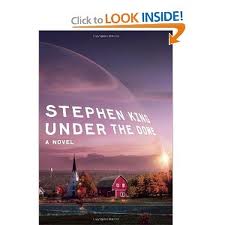
Under the Dome, by Stephen King

Saturday, January 08, 2011

If there are two things that Stephen King knows, it's character and setting.  Despite the bizarre situations that he places them in, his characters usually feel completely authentic.  In fact, I think that his real talent as a writer is imagining what the average person would do when confronted with the impossible.  In that sense, Under the Dome represents the most obvious example of what he has spent a career writing about.  He does nothing so well as place his characters under the microscope to see what they will do in in the most trying of circumstances.


Imagine that your entire town is suddenly cut off from the rest of the world by an impermeable, impenetrable barrier.  Nothing can go in or out.  In an instant, you become just one creature in a very large terrarium.  That is exactly what happens to the small Maine town of Chester Mills.  As the government outside the dome tries to figure out where it came from and how to get rid of it, the residents of The Mills go about the business of figuring out how to survive their captivity.  In classic King style, there is the corrupt town leader, the drifter with a past, the good-hearted average guy, the strong, feisty woman (in this case, the owner of the town paper), and a cast of townspeople (good, bad, or a little of both) who make up this particular microcosm of America.  If I thought about it long enough, I could probably match every main character from Under the Dome with their counterpart in The Stand (my favorite King book by a green mile!).  What makes this familiar cast work time after time is the fact that most of us know someone exactly like them.  The power struggle unfolds with a Lord of the Flies inevitability, with some people rising to the occasion, and others showing their true, evil nature.

My one criticism of this book is its length.  I'm not averse to a 1000+ page book, if all 1000+ pages are integral to moving the story along.  However, the middle 400 pages or so of this particular tome dragged.  I suppose when you have a story with this many moving parts (there are something like 20 important characters, with many more minor characters), you run the risk of getting bogged down in each individual storyline.  In the end, however, it was worth it.  The last 100 pages were fast-paced and exciting.  And in an example of another thing I love about King's writing, there are no safe characters.  This gives his writing a delicious unpredictability.    But, satisfactorily, the truly bad guys almost always get what's coming to them.
 
FREE BLOGGER TEMPLATE BY DESIGNER BLOGS